
Basalt Fiber Reinforced Polymer (BFRP) Rebar
Basalt Fiber Reinforced Polymer (BFRP) rebar is a composite reinforcement manufactured from continuous basalt fiber and a polymer matrix.
The performance of BFRP reinforcement is determined not by the fiber alone, but by the complete technological system:
Basalt raw material → Continuous basalt fiber → Roving → Resin impregnation → Rebar forming → Curing → Finished BFRP reinforcement
Stable production therefore requires coordinated control of fiber properties, roving structure, sizing and resin compatibility, impregnation, fiber content, forming conditions, curing parameters and surface geometry.
This integrated technological approach is particularly important when developing a new BFRP production line or adapting existing equipment to basalt fiber.
From Basalt Roving to Composite Reinforcement
Continuous basalt fiber roving is the principal reinforcing component of BFRP rebar.
The characteristics of the roving directly influence processing stability and the mechanical properties of the finished composite. Important parameters include:
- filament diameter and its stability;
- linear density of the roving;
- tensile properties;
- integrity of the roving during processing;
- sizing type and content;
- compatibility between sizing and polymer matrix;
- wet-out and impregnation behaviour;
- stability under the tension applied during continuous production.
A high-strength fiber does not automatically produce high-quality composite reinforcement.
The fiber must be converted into a stable roving capable of passing through the impregnation and forming system without excessive filament damage while providing uniform distribution of the polymer matrix throughout the reinforcement cross-section.
BFRP Rebar Production Technology
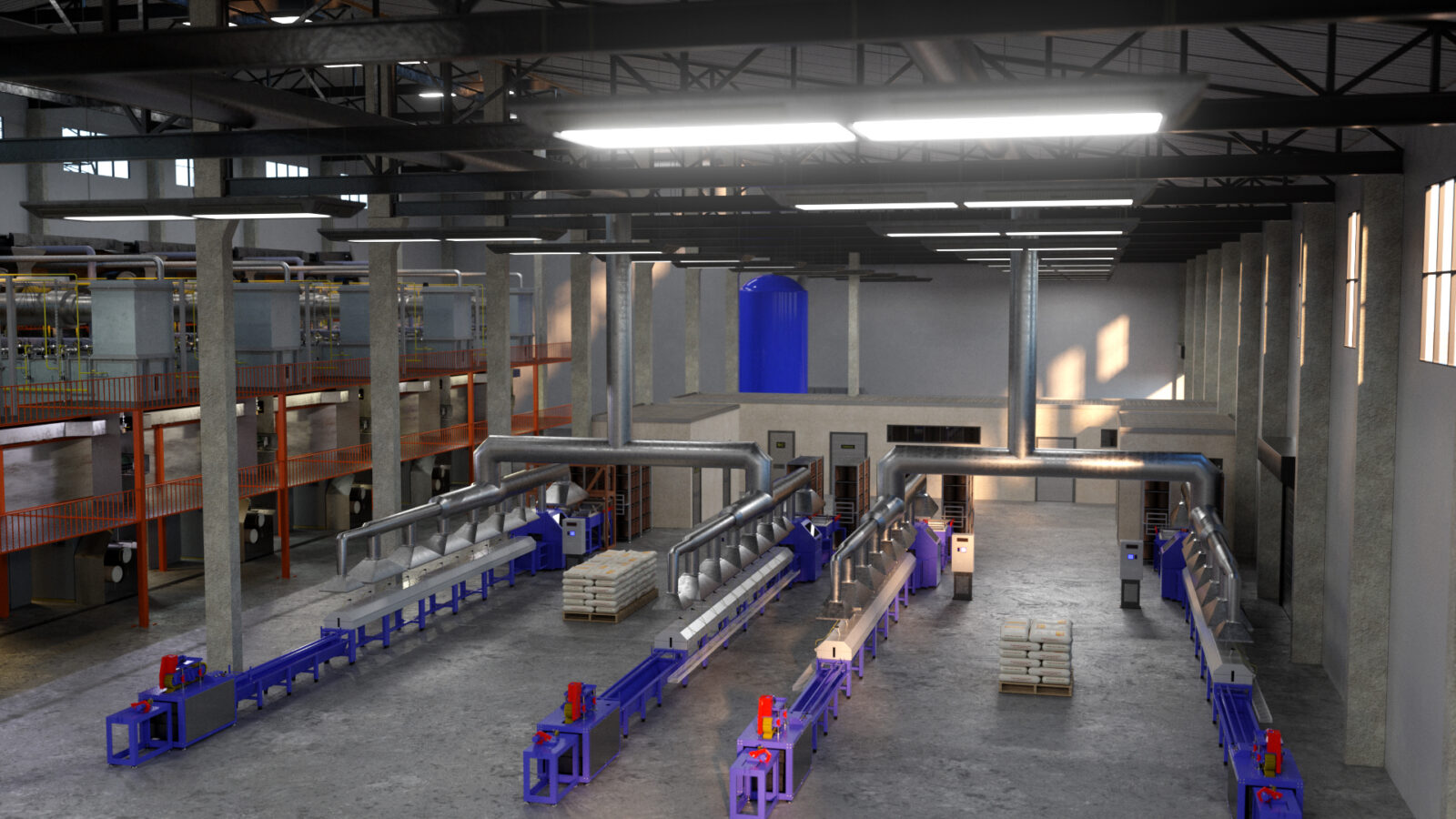
Industrial production of basalt composite reinforcement is normally organized as a continuous process.
The principal technological stages are:
Roving supply → Tension control → Resin impregnation → Strand consolidation → Rebar forming → Surface profile formation → Polymerization / curing → Pulling → Cutting → Inspection and packaging
Roving Supply and Tension Control
Basalt rovings are supplied from a creel system.
Stable and controlled tension of individual rovings is important for maintaining uniform fiber distribution within the reinforcement and preventing local variation in the composite structure.
Resin Impregnation
The rovings pass through an impregnation system where the polymer matrix must penetrate the fiber bundle.
The objective is not simply to coat the outside of the roving. Effective impregnation should provide sufficient wetting of the filaments and minimize dry zones, voids and local resin-rich areas.
Forming
After impregnation, the fiber-resin system is consolidated into the required cross-section.
The forming system determines the geometry of the reinforcement and contributes to control of fiber distribution and resin content.
Surface Formation
Unlike conventional steel reinforcement, the required bond with concrete must be created technologically.
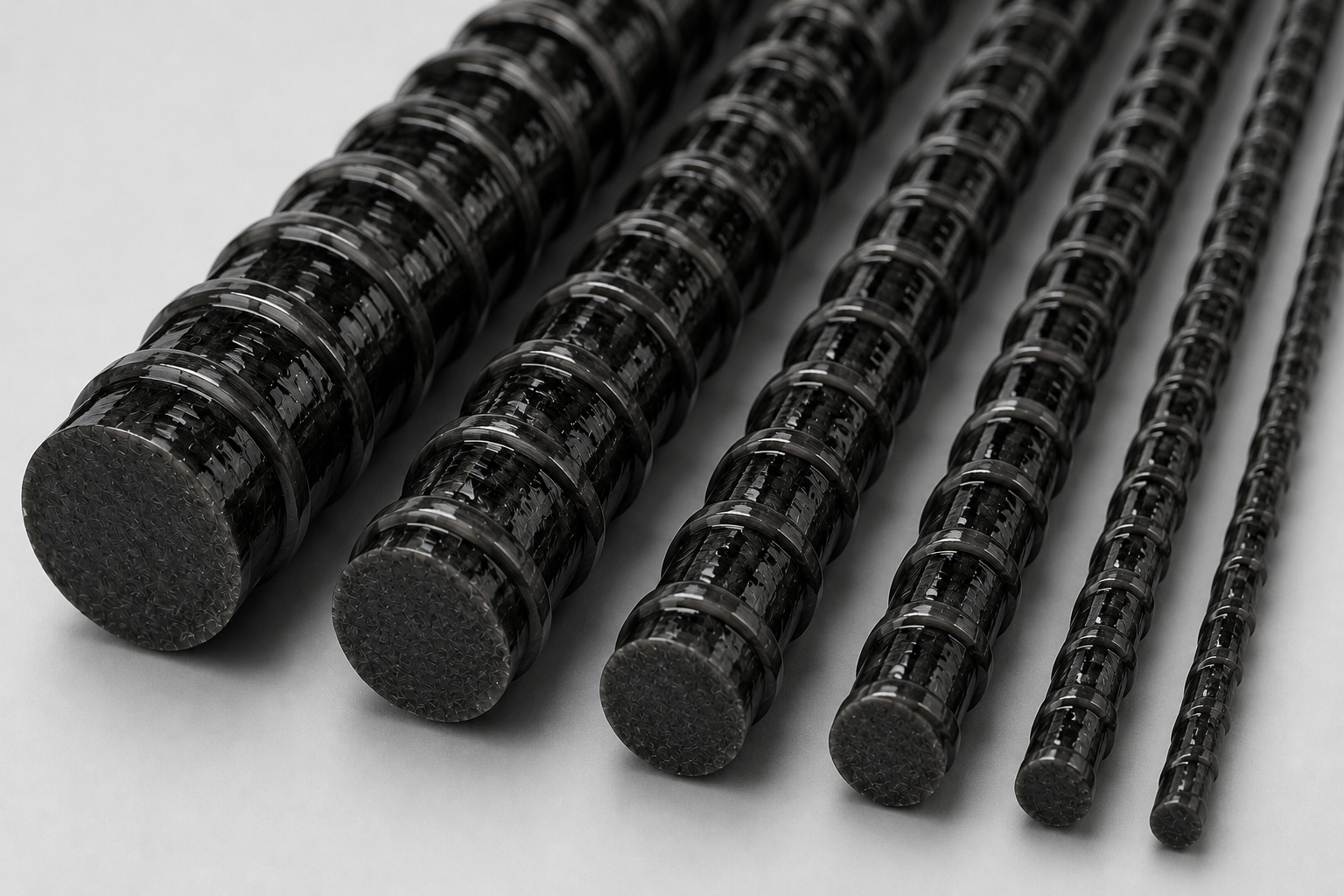
Depending on the selected process, the reinforcement surface may be formed using a spiral profile, additional winding, mineral coating or other surface treatment.
The surface geometry is therefore an important functional element of the product rather than simply an external feature.
Polymerization and Curing
The formed composite passes through a controlled curing system.
Temperature distribution, residence time, pulling speed and characteristics of the resin system must be coordinated to obtain the required degree of polymerization throughout the cross-section.
Cutting and Finishing
After curing, the continuous reinforcement is cut to the required length or processed according to the selected product configuration.
Finished products are then inspected, packaged and prepared for shipment.
Raw Materials and Polymer Matrix
The main components of BFRP reinforcement are:
Continuous basalt fiber + sizing system + polymer matrix
Different thermosetting resin systems may be used depending on the required product characteristics, production technology and operating environment.
Typical systems include epoxy, vinyl ester and polyester-based matrices.
Selection of the resin cannot be considered separately from the basalt fiber sizing.
The interface between the basalt filament and polymer matrix plays an important role in transferring mechanical loads through the composite. For this reason, sizing chemistry, resin chemistry and curing conditions should be evaluated as a single technological system.
Rebar Geometry and Surface Structure
BFRP reinforcement can be produced in different diameters and surface configurations.
The selected geometry depends on the intended application, required mechanical characteristics, bond behaviour with concrete and production technology.
Important parameters include:
| Parameter | Technological significance |
|---|---|
| Rebar diameter | Determines product cross-section and production conditions |
| Fiber content | Strongly influences mechanical properties |
| Fiber distribution | Required for structural uniformity |
| Resin content | Influences impregnation, durability and composite quality |
| Surface profile | Influences bond with concrete |
| Curing degree | Influences mechanical and long-term properties |
| Straightness and dimensional stability | Important for construction use and handling |
Process parameters must normally be adjusted when the product diameter or surface configuration changes.
Characteristics of BFRP Reinforcement
Basalt fiber composite reinforcement combines the mechanical properties of continuous mineral fibers with the corrosion resistance of a polymer composite.
Typical characteristics include:
| Characteristic | BFRP Reinforcement |
|---|---|
| Reinforcement | Continuous basalt fiber |
| Matrix | Thermosetting polymer |
| Density | Approx. 1.9–2.1 g/cm³ |
| Corrosion | Non-corrosive |
| Electrical conductivity | Electrically non-conductive |
| Magnetic behaviour | Non-magnetic |
| Thermal conductivity | Significantly lower than steel |
| Production | Continuous composite forming process |
Mechanical properties should always be specified for the actual product and diameter rather than treated as universal values for all basalt reinforcement.
They depend on the properties of the fiber, fiber volume fraction, matrix, impregnation quality, curing conditions, geometry and manufacturing technology.
BFRP Rebar and Steel Reinforcement
BFRP reinforcement should not be considered simply as a direct replacement for steel in every concrete structure.
The two materials have fundamentally different physical and mechanical behaviour.
The principal advantages of BFRP are associated with low density, corrosion resistance, electrical insulation and non-magnetic behaviour.
Steel, however, has a substantially higher elastic modulus and different structural behaviour.
For this reason, selection of BFRP reinforcement should be based on engineering requirements and appropriate structural design rather than only on a comparison of tensile strength.
This is especially important for projects where durability, corrosion exposure or electromagnetic requirements are decisive.
Applications
BFRP reinforcement can be considered for concrete structures where corrosion resistance, low weight or electrical and magnetic neutrality provide a technical advantage.
Typical applications include marine and coastal structures, infrastructure exposed to chlorides and de-icing salts, industrial and chemical environments, concrete structures exposed to moisture, tunnels, special electrical installations and other reinforced concrete applications requiring non-corrosive reinforcement.
The suitability of BFRP for a particular structure must be evaluated according to the applicable structural design requirements and standards.
Technology and Equipment
Production of reliable BFRP reinforcement requires more than installation of a standard pultrusion line.
Equipment configuration and technological parameters must correspond to the characteristics of the basalt roving, selected resin system, required reinforcement diameter, surface profile and production capacity.
A production system may include:
Roving creels → Tension control → Impregnation system → Forming unit → Surface-forming system → Curing system → Pulling equipment → Cutting → Product handling and packaging
The configuration can be developed for a new production facility or adapted to existing composite-processing equipment.
Mineral 7 Technical Approach
Mineral 7 approach basalt composite reinforcement as part of the complete basalt technology chain rather than as an isolated composite product.
Experience with basalt raw materials, mineral melting, continuous basalt fiber production, roving formation and downstream processing makes it possible to evaluate the interaction between the properties of the original fiber and the requirements of the finished composite.
Technical work may include:
- evaluation of basalt roving for BFRP production;
- selection and adaptation of technological processes;
- evaluation of resin and sizing compatibility;
- development of production parameters;
- analysis and selection of equipment;
- development of production-line configurations;
- assessment and optimization of existing lines;
- pilot and industrial trials;
- troubleshooting of impregnation, forming and curing processes;
- technical support during commissioning and production development.
For new projects, equipment may be developed for the required production concept or selected from specialized equipment manufacturers and integrated into a complete technological solution.
Project Development and Technical Support
A BFRP project can be evaluated from individual process problems to development of a complete production concept.
The objective is to establish a technically balanced system in which fiber properties, polymer chemistry, equipment configuration and production parameters correspond to the required finished product.
For technology development, equipment evaluation and BFRP production projects:
For independent technical advisory and expert support: